Professor
Michelle Hartman is Professor of Arabic Literature at the Institute of Islamic Studies, McGill University, where she has worked since 2002. She teaches in all areas of Arabic literature and is especially interested in the way in which creative languages are used in literary texts, the connections between the politics of literature and its poetics and literature as resistance. One of her main areas of focus in her research is the politics of translation from Arabic to English, particularly the way in which theory and practice do and do not come together.
Her literary and translation research is primarily on women writers from Lebanon, Syria, and Palestine. She ha published a number of books--more information can be found on the Publications tab above. Native Tongue, Stranger Talk (Syracuse University Press, 2014) is an anti-colonial reading of how women writers from Lebanon who write in French use Arabic words to advance messages about gender, nation, ethno-religious belonging and class in their novels. Breaking Broken English: Black Arab Solidarity and the Politics of Language (Syracuse University Press, 2019) explores how poetry and fiction by Arab and Arab American writers express literary solidarities with African Americans, and uses Black intellectual and theoretical work to probe the use of language in a series of works. It is the inaugural volume in the Critical Arab American series at Syracuse University Press and winner of the College Language Association Award for Creative Scholarship in 2020.
More recently, she has collaborated on a multi-year SSHRC-funded project on women's stories and histories of the Lebanese Civil War with colleague Malek Abisaab. See publications including What the War Left Behind: Women's Stories of Resistance and Struggle in Lebanon (2024) and Women's War Stories: The Lebanese Civil War, Women's Labor, and the Creative Arts.
In addition to her academic research and writing on the Politics of Translation from Arabic to English, Michelle also is a literary translator. She has translated eight novels, a memoir, and a short story collection. Her commitment to connecting theory and practice of translation emerges out of this experience of translation.
For more information on these projects, please click on the publications and translations tabs above.Publications
BOOKS:
What the War Left Behind: Stories of Women's Struggle and Resistance, Syracuse University Press, 2024. (with Malek Abisaab)

An interview with the authors on Jadaliyya
Description: Conspicuously missing from narratives of the Lebanese Civil War are the stories of women who took part in daily social activism and political organizing during the tumultuous conflict. What the War Left Behind documents their stories, with eight women directly sharing their experiences of action and survival through the hardship of war.
What the War Left Behind brings together oral histories of women from a range of political affiliations, socioeconomic classes, and religious identities. These histories present an alternative image of women during war, highlighting the actions of those who sought to make life better for themselves and their neighbors during conflict. By centering women’s voices in the war, Abisaab and Hartman present a new perspective on an oft-discussed historical era, demonstrating the power of resistance during difficult times. These translated texts showcase the active roles women take during wartime and how women’s political efforts are an essential part of Lebanese history.
Praise:
"This book rings with whispered knowing and sings aloud of struggle and striving in stories that did not die, and truths that will not be erased, because they are told here."—Tracey Jean Boisseau, Purdue University
Women's War Stories: The Lebanese Civil War, Women's Labor, and the Creative Arts, Syracuse University Press, 2022 (with Malek Abisaab)

An interview with the editors on Jadaliyya
Description: Women have consistently been left out of the official writing of Lebanese history, and nowhere is this more obvious than in writing on the Lebanese Civil War. As more and more histories of the war begin to circulate, few include any in-depth discussion of the multiple roles women played in wartime Lebanon. Fewer still address the essential issues of women’s work and their creative production, such as literature, performance art, and filmmaking.
Developed out of a larger oral history project collecting and archiving the ways in which women narrated their experiences of the Lebanese Civil War, this book focuses on a wide range of subjects, all framed as women telling their “war stories.” Each of the six chapters centers on women who worked or created art during the war, revealing, in their own words, the challenges, struggles, and resistance they faced during this tumultuous period of Lebanese history.
Praise:
"Women’s War Stories is destined to become a required textbook in history; Middle East, war, and gender studies; and postcolonial and cultural studies."—Arab Studies Quarterly
"Every essay attests to women’s creative and practical initiatives during a reign of terror and brings the reader to Lebanon’s vibrant contemporary art scene."—Al Jadid
"This powerful collection of essays centers the lived experiences of women trapped in the vise of violence and war. Their narratives remind us of the power of art and remembering in healing wounds from the past. Such stories, rendered gracefully here, allow us to imagine a better future. The editors and contributors have done a masterful job of restoring the voices of those ignored, excluded, and erased, to give us a deeper understanding of a time that many would simply like to forget. But in forgetting, they risk the peril of repeating."—Beth Baron, City University of New York
"Some 30 years after the Civil War, women laborers, domestic workers, rappers, graffiti artists, film-makers and others, have boldly contributed to the herstory of unfolding Lebanon. Hartman and Abisaab have anticipated the importance of these vital narratives, buried for decades, and have created a compelling book that not only uncovers the truths about Lebanon’s past but sheds light on the Lebanon of today."—Elise Salem, Lebanese American University
"A masterfully curated collection of displaced cultural and social histories of women's labor, experiences and imagination in Lebanon. Women’s War Stories demonstrates the history of the Lebanese civil war must center on gender."—Stephen Sheehi, author of Camera Palaestina: Photography and Displaced Histories of Palestine
"This book provides a fresh and largely unique perspective of how the 'civil war' between 1975 and 1990 impacted several women artists and activists."—Malek Khouri, The American University in Cairo
"Women’s War Stories offers unheard and sometimes private stories of those who have experienced the Lebanese civil war. The feminist angle is important not only for the focus on women’s lives but as a framework of analysis that underscores the ethical/epistemological limits as well as the possibilities borne out of story-making."—Dina Georgis, University of Toronto
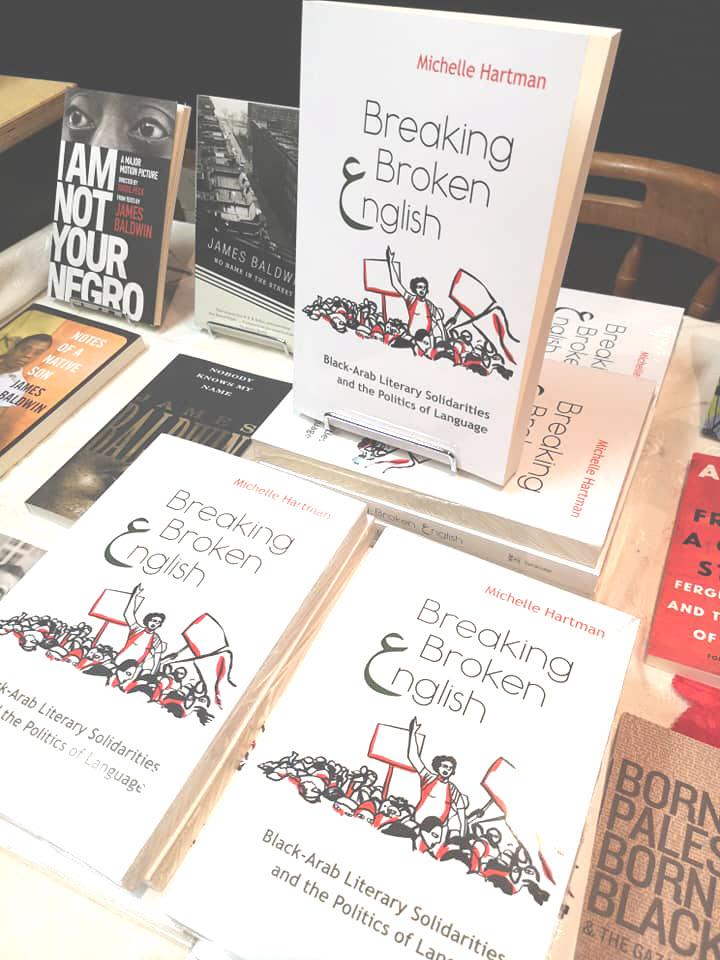
Breaking Broken English: Black-Arab Literary Solidarities and the Politics of Language, Syracuse University Press, 2019.
Winner of the College Language Association Prize for Creative Scholarship (2020)
 Description: This book is an exploration of the long and complex histories of how solidarities between Black Americans and Arabs, Arab Americans and Palestinians especially are and have been expressed in literary works by Arab American authors over time. It engages poetry, fiction, and memoir by a range of authors.
Praise:
“Michelle Hartman plumbs the polysemy of ‘breaking’ with rich analytical acuity, compelling us to read solidarity across a wide range of literary and linguistic practices.”—Keith Feldman, University of California, Berkeley.
“Hartman’s thought-provoking analysis of a variety of work from poetry to short fiction to novels to memoir offers an understanding of how language and racial politics have impacted the way Arab Americans position themselves in American society.”—Pauline Kaldas, Hollins University.
"A superb follow up to Native Tongue, Stranger Talk, Michelle Hartman's Breaking Broken English theorizes about the linguistic, aesthetic, and political connections between Blacks and Arabs in the United States. Hartman deftly analyzes Arab American work with Black Studies as a critical lens, offering radical reading strategies that fundamentally shift how we understand Arab American letters. Breaking Broken English should be required reading for anyone seeking to understand the field.” —Professor Therí Pickens, Bates College.
For more information from Syracuse University Press and to order, please click here.
Teaching Modern Arabic Literature in Translation, Modern Language Association, 2018.
Honorable mention Idaho State Teaching Literature in Translation Book Award.
 Description: Understanding the complexities of Arab politics, history, and culture has never been more important for North American readers. Yet even as Arabic literature is increasingly being translated into English, the modern Arabic literary tradition is still often treated as other—controversial, dangerous, difficult, esoteric, or exotic. This volume examines modern Arabic literature in context and introduces creative teaching methods that reveal the literature’s richness, relevance, and power to anglophone students.
Addressing the complications of translation head on, the volume interweaves such important issues such as gender, the Palestinian-Israeli conflict, and the status of Arabic literature in world literature. Essays cover writers from the recent past, like Emile Habiby and Tayeb Salih; contemporary Palestinian, Egyptian, and Syrian literatures; and the literature of the nineteenth-century Nahda.
Teaching Modern Arabic Literature in Translation is available here. For Canadian buyers please click here.

Native Tongue, Stranger Talk: The Arabic and French Literary Landscapes of Lebanon, Syracuse University Press, 2014.
- Book Review in as-Safir
- Book Review in Journal of Middle East Women’s Studies
- Book Review in International Journal of Middle East Studies
- Book Review in SCTIW journal
- Featured in AMEWS E-Bulletin
Joseph, Jesus and Job: Readings of Intertextual Rescriptings of Religious Figures in Lebanese Women’s Fiction Wiesbaden: Reichert Verlag, 2002.

SELECTED ARTICLES
On Lebanese Women's Fiction
"Zahra's Uncle, or Where are Men in Women's War Stories?" Journal of Arabic Literature 50 (2020): 83-107
Co-authored pieces on Language, Race, and Solidarity
rosalind hampton and Michelle Hartman, "Solidarity in Multiple Registers" Curriculum Inquiry 52:3 (2022): 326-336.
rosalind hampton and Michelle Hartman, “Whose Values, Who’s Valued?: Race and Racialization in Quebec.” Journal of Critical Race Inquiry 6:1 (2019): 1-31
rosalind hampton and Michelle Hartman, "Towards Language and Resistance: A Breaking Manifesto” in Outsider Imperatives: Manifestos for World Thought Jason Bahbak Mohaghegh and Lucian Stone eds. London, Palgrave (2017): 115-128.
On Black Arab Solidarity
“Dreams Deferred, Translated: Radwa Ashour and Langston Hughes” in CLINA Journal 2:1 (2016)
Other Selected Articles and Book Chapters (2016 and before):
“Translating a Literary Tradition: Arabic Literature” in the volume Teaching Translation: Programs, Courses, Pedagogies, edited by Lawrence Venuti. London/New York: Routledge, (2016): 117-125.
"'My Tale’s Too Long to Tell': The Locust and the Bird between South Lebanon and New York City” Journal of Arabic Literature, 46: 2-3 (2015): 168-192.
“A “Druze Novel” as World Literature?: Rabih Alameddine’s I, the Divine,” The Edinburgh Companion to the Arab Novel in English: The Politics of Anglo Arab and Arab American Literature and Culture. Ed. Nouri Gana. Edinburgh: Edinburgh University Press (2013): 339-359.
“Gender, Genre and the (Missing) Gazelle: Arab Women Writers and the Politics of Translation” Feminist Studies, 38:1 (Spring 2012): 17-49.
“An Arab Woman Writer as a Cross-Over Artist: Reconsidering the Ambivalent Legacy of Al-Khansa’,” Tulsa Studies in Women’s Literature, 30:1 (Spring 2011): 15-36. (appeared fall 2012)
“Teaching Naguib Mahfouz as World Literature” Approaches to Teaching Naguib Mahfouz (Eds.) Wail Hassan and Susan Muaddi Darraj. New York: Modern Language Association, 2011, 114-128.
“Grandmothers, Grape Leaves and Kahlil Gibran: Writing Race in Anthologies of Arab American Literature,” Race and Arab Americans Before and After 9/11: From Invisible Citizens to Visible Subjects (Eds.) N Naber and A Jamal, Syracuse University Press, 2008, 170-203.
"‘this sweet/sweet music’: Jazz, Sam Cooke and Reading Arab American Literary Identities” MELUS Journal special issue on Arab American Literature, 31:4, winter 2006, 145-166
“Writing Africa(ns) in America: Adonis and Radwa Ashour From Harlem to Lady Liberty” International Journal of Middle East Studies, 37:3, Aug 2005, 397-420
“Besotted with the Bright Lights of Imperialism: Arab Subjectivity Constructed Against New York’s Many Faces” Journal of Arabic Literature 35.3, Fall 2004, pp. 270-296
“The First Boat and the First Oar: Inventions of Lebanon in the Writing of Michel Chiha” (co-authored with Alessandro Olsaretti) Radical History Review, Spring 2003, pp. 36-65
Breaking Broken English
Breaking Broken English: Black-Arab Literary Solidarities and the Politics of Language, Syracuse University Press. Winner of the 2020 College Language Association Award for Creative Scholarship.
 This book is an exploration of the long and complex histories of how solidarities between Black Americans and Arabs, Arab Americans and Palestinians especially are and have been expressed in literary works by Arab American authors over time. It engages poetry, fiction, and memoir by a range of authors.
“Michelle Hartman plumbs the polysemy of ‘breaking’ with rich analytical acuity, compelling us to read solidarity across a wide range of literary and linguistic practices.”—Keith Feldman, University of California, Berkeley.
“Hartman’s thought-provoking analysis of a variety of work from poetry to short fiction to novels to memoir offers an understanding of how language and racial politics have impacted the way Arab Americans position themselves in American society.”—Pauline Kaldas, Hollins University.
"A superb follow up to Native Tongue, Stranger Talk, Michelle Hartman's Breaking Broken English theorizes about the linguistic, aesthetic, and political connections between Blacks and Arabs in the United States. Hartman deftly analyzes Arab American work with Black Studies as a critical lens, offering radical reading strategies that fundamentally shift how we understand Arab American letters. Breaking Broken English should be required reading for anyone seeking to understand the field.” —Professor Therí Pickens, Bates College.
Journal of Blacks in Higher Education recommends Breaking Broken English as “Recent Book of Interest to African American Scholars", also on Twitter: https://twitter.com/JBHEdotcom/status/1126510065597337601
Read an interview with Michelle about the book on Jadaliyya.
For more information from Syracuse University Press and to order, please click here.
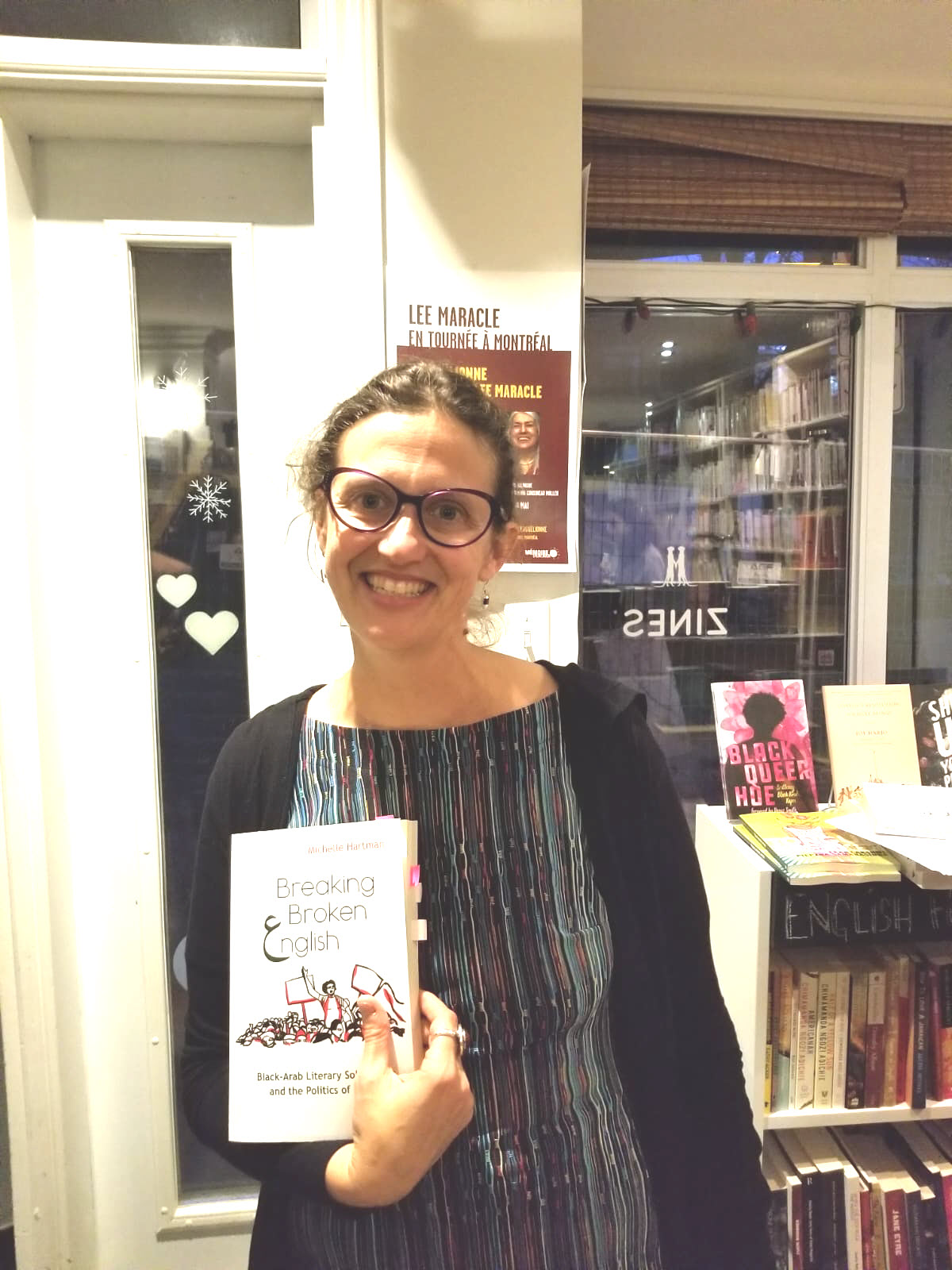
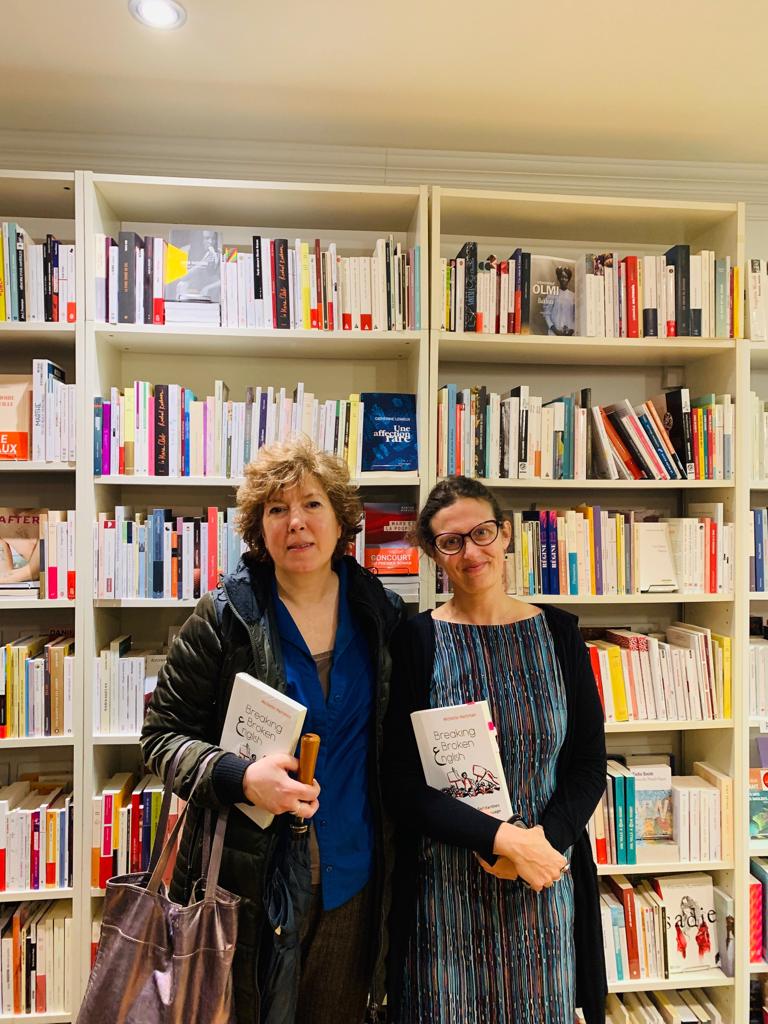
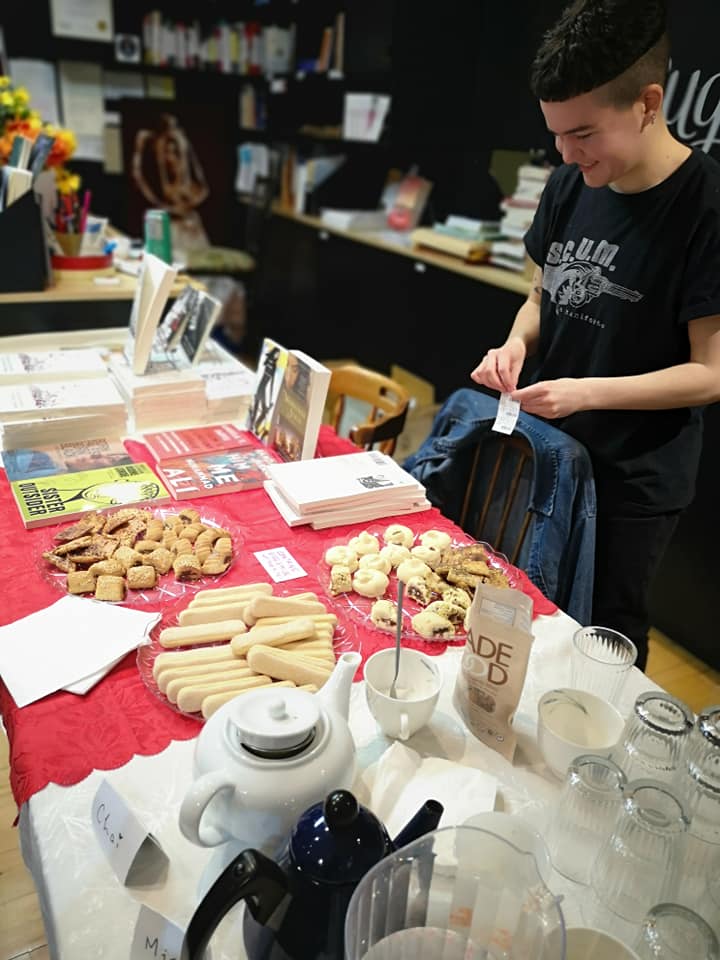
Book Launch in Montreal on Friday April 26, 2019 at Eugélionne, Librarairie Féministe


Click here for facebook event page.
Book Launch in New York City on Thursday May 9, 2019 at Bluestockings Cooperative Bookstore, Café & Activist Space

Click here for NYC Facebook page
To order a copy, please click here.
Translations
Translations of Novels from Arabic to English:

Songs for Darkness by Iman Humaydan
Longlisted for The International Prize for Arabic Fiction (IPAF)
- "On Songs for Darkness, the stories of four Lebanese women," Interview
- Excerpts from the novel, ArabLit
- "In Conversation: Songs as Memory, as Solidarity, As Resistance" Interview
- Podcast Interview with Michelle here
Description of the novel:
Only songs are able to comfort the soul in its darkness—but can anyone hear them?
Iman Humaydan’s saga recalls the voices of four generations of women from one family in the imaginary village of Kasura, in Mount Lebanon. Its narrator, Asmahan, named after the beloved Syrian singer, has devoted her adult life to recovering the stories of her ancestors, who persisted in the shadows of male supremacy, war, military occupation, and impoverishment.
Her mother, Layla, disappeared when Asmahan was still a teenager. Her grandmother, Yasmine, died giving birth. And her great-grandmother, Shahira, struggled through two world wars, famine, and suffocating gender norms to win an education for her children and eke out a better life for her family. Asmahan is determined to protect her daughter and break out of the cycle of intergenerational violence and wounds that the women who came before her suffered. She packs up her daughter to emigrate after a divorce, when her husband takes their son away from her on his seventh birthday, during the darkest days of the 1982 Israeli invasion.
These women’s legacies span and echo the scarred history of an abused homeland, from the eve of the first World War to the 1982 Lebanon War. In honoring their unfulfilled lives, Iman Humaydan insistently preserves intimate stories of abundant tenacity, generosity, sacrifice—and songs, provisions sorely needed for dark times.

A Long Walk from Gaza by Asma Alatawna (co-translated with Caline Nasrallah)
Long-listed for the Saif-Banipal Prize for Arabic Translation
- "A Conversation about A Long Walk from Gaza" with Asmaa Alatawna, Caline Nasrallah, and Michelle Hartman on Rowayat
- "A Gazan Woman's Voice: Michelle Hartman and Caline Nasrallah on translating Asmaa Alatawna's A Long Walk from Gaza" Asymptote
Description of the book:
The violence of life in Gaza which has taken on immense proportions for the whole world to see is intimately rendered here in a human story of resistance and resilience.
In the tradition of Palestinian women writers, Asmaa Alatawna has gifted us a novel that is both personal and political, that exposes both the occupation and the patriarchy. A Long Walk from Gaza is a coming-of-age story that follows its teenage protagonist through her battles with a strict and abusive father, the exhilaration of her first crush, confrontations with occupation soldiers, and the heartbreak of leaving her home Gaza for a new life in Europe. Beginning in Europe and working backward to her own birth and early childhood, Alatawna’s creative narration mirrors the traumas of her life and her people.
A Long Walk from Gaza not only exposes the harshness of both male authority and the stifling of the dreams of girls in parallel with the devastating conditions Palestinians endure under a brutal Israeli occupation, but also the challenges of fleeing these for a cold, alienating life in Europe. Alatawna lays these bare within a story that also showcases moments of humor, joy, and the human capacity to survive and thrive at all costs. She skillfully weaves together the challenges of growing up in occupied Palestine while exposing the many intersections of violence, patriarchy, and growing up in a society that offers girls little to no compassion. Her teenage protagonist’s feminist point of view is fresh and honest, powerfully conveying the heartbreaking truths of her life.
At heart, A Long Walk from Gaza is a tale of freedom. Each of the characters is psychically wounded by their circumstances and each resists in their own way. Gaza comes to life in Alatawna’s novel, showing a rich and diverse society—its flaws along with its beauty, showing us worlds, which are being destroyed and some of which no longer exist today.
Kirkus Review
A tale of trauma.
Alatawna, a Palestinian Bedouin and now a French citizen, makes a stirring book debut with a coming-of-age novel set amid Middle East turmoil. Translated by Nasrallah and Hartman, the narrative begins in Europe, where the unnamed protagonist has for two years been struggling to get a residence card to enable her to stay in France. The process is dehumanizing, she admits, but nothing like her experiences in what she calls the “open-air prison” of Gaza, where she grew up, victimized and oppressed by her family, a patriarchal society, and the Israeli military. Her father, she reports, “regularly beat me into submission, turning me black and blue as he tried to quell my constant rebellion”—refusing to wear the hijab, for example. “Where we lived, even the smallest thing frightened us,” she reveals. “We were afraid of dying, afraid of worms eating away at our flesh. Rumors instilled a fear in us that even the Israeli missiles couldn’t, though we were well aware that these might fall from the sky at any moment and decimate us.” After being suspended from college for her defiance, she found work at a Spanish news agency where she met José, a non-Arab Muslim who helped her escape. In 2001, she was in Madrid but soon left, beginning a yearslong flight from Spain to France, as she ran “from one country, one emotional state to another,” finally ending up in a women’s shelter in Toulouse, so traumatized that she could not speak. Most of the novel recounts a past from which the narrator can never escape: humiliation at the hands of the occupiers, feuds and racism within the Afro-Palestinian community, loss and betrayals, and unremitting violence.
Sadly, a timely look at a brutal reality.

Memoirs of a Militant: My Years in the Khiam Women's Prison by Nawal Qasim Baidoun (co-translated with Caline Nasrallah)
- Read an excerpt in the Markaz Review here
- Review: "Resistance and Revolutionary Will" by Mary Turfah in Liberated Texts
- Article: "Abjection and Identity in al-Khiam Detention Camp" by Fatme Abdallah in International Journal of Transitional Justice.
Description:
An important message about the need to liberate prisoners and the call for solidarity in the face of injustice
Shattering the notion that Muslim women did not play an active role in armed resistance national liberation struggles
“In order to carry on with life in prison, you must believe you will be there forever.”
In the haunting and inspiring Memoirs of a Militant: My Years in the Khiam Women’s Prison Nawal Baidoun offers us her first-person account of the life of a young woman activist imprisoned for four years, as well as the events leading up to her arrest and detention. Born into a nationalist family in Bint Jbeil, Lebanon, not far from the location of the prison itself, Baidoun, like so many others, found herself compelled to take up arms to resist the Israeli occupation. Her memoir skillfully weaves together two stories: that of the oppressive conditions facing ordinary people and families in South Lebanon, and that of the horrors of daily life and the struggle for survival inside the prison itself.
Arrested for her role in planning the assassination of the well-known Israeli agent and collaborator, Husayn Abdel Nabi, Baidoun was at one point detained with Soha Bechara, a fellow militant whose similar operation is better known. Her activism rooted in her Islamic faith, Baidoun shatters the notion that Muslim women did not play an active role in the armed resistance. Much like her sisters in Algeria and Palestine, Nawal Baidoun belongs to a generation of Muslim women in the Arab world who played a significant role in their national liberation struggles. She describes the intense mental and physical torture she endured, and her refusal to confess despite this. Memoirs of a Militant offers us rare and unique insight into the strength and courage of Baidoun in extreme circumstances and conditions. Nawal Baidoun herself has said that she wrote this book as a sort of history lesson for the generations who come after her, to show the ways in which women actively took part in the resistance and struggle against the occupation. Her strongly abolitionist message about prisons and the need to liberate all prisoners and detainees resonates strongly today, as does her call for solidarity in the face of injustice.

Without by Younes Alakhzami (co-translated with Caline Nasrallah)
Description:
Without tells a story of searching for belonging both in the world and within your own skin. Born in Saudi Arabia to a Yemeni family, the novel’s protagonist has been ill-at-ease since childhood, because she never felt like she was a girl. Alia’s alienation grows as she slowly comes to realise that she is, in fact, a man and begins the transition to live life as Ali.
This is a very important story to tell as it portrays the struggles of gender non-conforming people in society. The novel is sensitive and frank in how it approaches an intersex person’s struggles with the realities of love, friendship, and survival against the backdrop of a life lived between Saudi Arabia and Yemen, and then later the UK. Without navigates complex issues in a very human way, painting an honest portrait of how people come to terms with challenges they never expected they would face. Told in a deceptively simple style, through a tightly woven and skillful narration, Without makes these struggles resonate with us all.

All the Women Inside Me by Jana Elhassan
Shortlisted for The International Prize for Arabic Fiction (IPAF)
A conversation about the novel with Jana Elhassan, Michelle Hartman, and Turgul Mende
Description:

Summer with the Enemy by Shahla Ujayli
Shortlisted for The International Prize for Arabic Fiction (IPAF)
Read an excerpt of the novel here
Description:
An Intergenerational tale of life and love seen through the eyes of three women from Raqqa
The western popular imagination about the now devastated city of Raqqa, Syria is filled with static and clichéd images of the Arab world. On the news, Raqqa looks like a dusty and abandoned desert village overrun by ISIS and other brands of Islamic fundamentalists, making its desperate, impoverished people yearn to flee at all costs. In the Arab popular imagination, the image of Raqqa is not much different—this ancient city, nestled along the Euphrates river in northeastern Syria, is typically thought of by Arabs as a remote Bedouin outpost, far removed from the nearest large metropolis, Aleppo.
People’s real lives, however, are always more complex. Nothing could help bring these real and complex histories to more widespread attention than Shahla Ujalyli’s brilliant new novel, Summer with the Enemy. This novel is a compelling tale that follows the charming, if at times difficult, everyday life of three women—Lamis, her mother Najwa, and her grandmother Karma – and all of the complexities of their relationships with each other, their extended family, and the wider social worlds they inhabit. The diversity of life in Syria, especially Raqqa, is on display throughout this book, and the stories told in its seven chapters move back and forth between time and place, with attention to the intimate details of lives and relationships, and with an eye to the larger historical and political contexts in which they live.
An intergenerational novel, Summer with the Enemy traces the lives of these women not only in Raqqa where the bulk of the novel is set, but also in the places their families lived before — Turkey, Jerusalem, Aleppo and Damascus. It reminds us that Syria and Syrians have never been isolated from the world, and that indeed the lives of people stretched far beyond the confines of Raqqa’s city limits, long before the online world existed.

A Sky so Close to Us translation of Shahla Ujayli’s Arab Booker (IPAF) prize nominated novel.
ArabLit interview with Michelle Hartman February 11, 2019
“A Syrian woman reckons with personal illness in parallel with the destruction of her homeland. Syria’s ongoing civil war provides the backdrop for Ujayli’s third novel (Persian Carpet, 2013, etc.) but doesn’t claim center stage; indeed, one theme of this globe-trotting, fatalistic tale is that catastrophes large and small lurk even if we escape a war zone. The narrator, Joumane Badran, is a Syrian native and humanitarian worker in her 30s living in Amman, Jordan, while her father and two sisters have remained in Syria, relating grim news of bombings and power plays by the ‘squalid archipelago of factions’ there. Joumane herself witnesses the impact secondhand, monitoring a refugee camp in Jordan, but the bulk of the novel focuses on two more interior concerns: her budding relationship with Nasser al-Amireh, a climate expert, and a cancer diagnosis that leaves her fearing death, wracked from chemotherapy and radiation treatment. Or, in other words, she’s focused on love and mortality, and her narrative sinuously moves from moments of grace to calamity and tragedy, past and present. Tales of coincidence and harsh irony abound, as when Joumane recalls that she'd met her oncologist decades earlier on family trips to Italy and that he’d gotten his degree in time to monitor his stepfather’s death. That’s just one case in which Ujayli ties up plotlines with a jet-black bow, but for all its concern with mortality and entropy, there’s plenty of narrative and intellectual energy in the story, as when Joumane recalls her father’s travels (he witnessed the 1963 March on Washington) or her friends' and sisters’ love affairs, which are tinged with mythos (Pygmalion, pirates). ‘The final truth is that your body is your homeland and the greatest treason is for it to betray itself,’ she writes, and the novel thoughtfully maps where self, family, and country intersect. A purposefully digressive and storm-clouded narrative, appropriate for capturing a Syrian expatriate’s mood.”
—Kirkus Reviews

The Journey by Radwa Ashour

The Ninety-Ninth Floor by Jana Fawaz Elhassan
- Book Review in Kirkus
- Book Review in The Common
- Book Review in Asymptote Journal
- Book Review in Arabic fiction
- Book Review in The National
- Book Review in Arabic Literature
- Book Review in The Jordan Times
- Book in Review in the New York Times

Weight of Paradise by Iman Humaydan
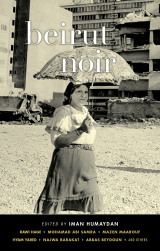
Beirut Noir an exciting collection of short stories from Akashic Books
- Book Review in Middle East Monitor
- Book Review in Qantara
- Book Review in The National
- Book Review in The Culture Trip
- Book Review in Publishers Weekly

Ali and His Russian Mother by Alexandra Chreiteh. Northampton: Interlink Books, 2015 [originally, Ali wa ummuhu al-russiyah]
Alexandra Chreiteh’s thoughts on being translated: http://arablit.org/2015/12/04/chreiteh/
Other Lives by Iman Humaydan. Northampton, Interlink Books (2014) [originally, Hayawat Ukhra]

Always Coca Cola by Alexandra Chreiteh. Northampton: Interlink Books, 2012. [originally, Da’iman Coca Cola]
- Book Review in AlJadid
- Book Review in the Egypt Independent
- Book Review in Warscapes
- Book Review in Words without Borders
- Book Review in New York Journal of Books
- Book Review in the Complete Review

Wild Mulberries by Iman Humaydan Younes. Northampton: Interlink Books, 2008. [originally Toot Barri]
-
The Saif Ghobash - Banipal Prize for Arabic Literary Translation
- Introduction to Wild Mulberries: Introduction to my translation of Iman Humaydan Younes’s novel, Wild Mulberries.

Just Like a River by Muhammad Kamil al-Khatib (co-translated with Maher Barakat) Northampton: Interlink Books, 2002. [originally Hakadha ka’l nahar]
Research
Areas of Interest
Arabic literature; Francophone literature of the Arab World; Arabic literature and the politics of translation; women's literatures; language use and literature; nationalism and literature.
Collaborative Research Project
Women’s War Stories: Building an archive of Women in the Lebanese Civil War
This is a multi-year SSHRC funded project Michelle has been working on with Professor Malek Abisaab, producing a number of publications, activities, and events. See our Women's War Stories website for more information.
Current Translation Projects
Also forthcoming soon!! Haneen Al-Sayegh's Mithaq al-Nisaa' will appear in October 2026 from Interlink as Daughters of the Same Secret.
For more information, see this interview with the author, "Haneen Al-Sayegh on Writing Women and Collective Solidarity" on ArabLit


Video about the book from the International Prize for Arab Fiction:
Other Translation-related Links
"Translation, Politics, and Solidarity: A Conversation Between two Translators" with Yasmeen Hanoosh and Michelle Hartman. ArabLit
Interview with Kholoud Elfallah in Romman Cultural Magazine about translating Arab women’s literature
Rules for Translators: 15 Rules for Translation by Chip Rossetti and Michelle Hartman
Other Links of Interest
Coverage of the events and related topics:
Interview with Dahna Abourahme and Lena Merhej
Interview with Dahna Abourahme, Lena Merhej and Michelle Hartman
Article about Ibrahim Nasrallah’s poetry reading
Related story
Courses and Supervision
Fall 2026 courses on offer (contact michelle.hartman [at] mcgill.ca) for more information:
ISLA 385, Poetics and Politics in Arabic Literature
ISLA 585, Arab Women's Literature (open to graduate and advanced undergraduate students)
Teaching and supervisory interest(s):
I teach courses on Arabic Literature, classical and modern, but particularly contemporary literature and literature written by women. The politics of language and literature, in particular the politics of translating Arabic into English is a major focus of my teaching.
I supervise graduate students in all areas of modern Arabic Literature, particularly literature written by women and work with students in translation theory and anti-colonial/ postcolonial feminist theories. My main supervisory interests are working with students engaged in thinking about language and literature, politics and poetics, and literary texts as resistance.
Past courses:
Undergraduate:
Poetics and Politics in Arabic Literature
Arabic Literature as World Literature
FYS: Narrations of the Modern Middle East
Muslim Societies
Islamic Civilization
Graduate/Undergraduate:
Arab Women’s Literature Graduate Seminars
Approaches to Literature in the Islamic World: Modern Arabic Literature
Reading and Writing Arab and Muslim Women
Poetics of the Arab and Muslim Diaspora(s)
Arabic Literature c500-1970s
Modern Arabic Literature: Gender, Language and Nation
Modern Arabic Literature: Theory and Practice of Translation
Moments in the Modern Middle East: Historical and Literary Approaches (co-taught with L Parsons)