On Thursday, November 28, 2024, the Institute of Parasitology gathered to celebrate the remarkable career and retirement of Professor Roger Prichard at Tadja Hall.


In a recent article, La Presse addressed the question of whether ultra-processed foods increase cases of attention deficit hyperactivity disorder (ADHD) and allergies in children.
Studies exist, Michèle Iskandar, Research Associate at McGill's School of Human Nutrition told La Presse—but they are preliminary.

McGill-led projects in genomics, imaging, and manufacturing serve businesses across Quebec

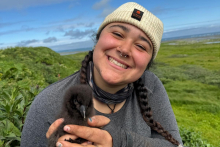
Collecting data on tufted puffins thanks to the Vivian Lewin and BELF Awards
In the eerie stillness of a misty Alaskan dawn, Cassandra Ciafro was already on the move by 3 a.m. Clad in camouflage, she melded seamlessly with the rugged cliffs, joining the seabirds in their lofty perches. Her mission? To deploy trackers and observe deitary patterns of the tufted puffin, a key indicator of the region’s fish stocks.
“I’ve always wanted to work with something related to marine science,” said Ciafro. “This experience has helped me grow so much as a person.”

Hear from Manuela Gonzalez Barrantes, first-year Environmental Biology student and Canada Award recipient from New Brunswick, on why she chose McGill, how the Canada Award made that dream into reality, and her big plans for the future.

In 1974, Chandra Madramootoo arrived at Macdonald Campus to pursue his BSc in Agricultural Engineering. He never left.
“I loved the program. I loved the professors. I loved my courses,” said Madramootoo. “It was giving me exactly what I wanted in life. I was fulfilling a dream.”
After also earning his MSc (1981) and his PhD (1985) at Mac, he accepted an 11th hour offer from McGill for an assistant professorship, declining opportunities at other universities.

He’s known as the king of cranberries. More than anyone else, Marc Bieler (DipAgr’58, BA’64) has contributed to Quebec’s thriving industry centred on a small red fruit with anti-inflammatory and antioxidant properties. Today, at the age of 86, this McGill alumnus continues to be involved in the day-to-day operation of the family business and to give back to the community.

The 2024 Scholastic Awards Reception on November 12th recognized more than 155 outstanding undergraduate students and close to 50 graduate students. The Faculty awarded over $400K in named scholarships at the undergraduate level and more than $340K in fellowships and awards at the graduate level.

On November 11, McGill University Bioresource Engineering Professor Zhiming Qi received the L.R. Ahuja Ag Systems Modeling Award at the annual Soil Science Society of America conference in San Antonio, Texas.
This prestigious honour is awarded by the American Society of Agronomy, Crop Science Society of America, and Soil Science Society of America to a soil scientist, agronomist, or crop scientist in recognition of recent distinguished contributions and their demonstrated impact on:

In a new article, La Presse investigates claims made by Robert F. Kennedy Jr., Donald Trump's Secretary of Health nominee, that Froot Loops sold in Canada have far less ingredients than their American counterparts.

Almond milk, oat milk, coconut milk, rice milk, macadamia milk... there have never been so many options to replace cow's milk on grocery shelves. But which one has the smallest environmental footprint?

Students at the Université de Sherbrooke have developed a tool that enables market gardeners to rid their fields of weeds more quickly and without resorting to herbicides, using AI-controlled robotics.

Researchers at McGill University have developed an eco-efficient, user-friendly technology that quickly measures the antioxidant content of maple syrup. The innovative method contributes to increasing transparency about a health-related aspect of the syrup's nutritional value and allows for on-site quality testing without the need for costly lab assessments.

Better educating farmers and food processors about how to avoid post-harvest food losses – which amount to one-third of global food production, worth US$1 trillion annually – would reduce global food insecurity, according to researchers at McGill University.

$13.8 million in federal funding for McGill’s cohort of 10 new, five renewed Canada Research Chairs